What Gets Carried: A Mother-Daughter Story About Math, Fear, and the Space to Try Again
There is a moment in La Mama when the kitchen goes quiet in a very specific way. Not the peaceful quiet of homework finished, or the tense quiet of a timed test. It is the quiet of a mother watching her daughter freeze over a worksheet and recognizing the freeze. She knows that look. She has worn that look. And for a beat, the film lets us understand something uncomfortable: math anxiety is often a family inheritance, passed down without a will, a signature, or anyone’s permission.
La Mama does not treat that inheritance as a punchline. It treats it as a relationship. As the film travels the 2026 festival circuit, audiences keep bringing up the same scene: the mother-daughter math conversation that starts as a familiar domestic standoff and ends somewhere closer to repair. It is not a magical tutoring montage. Nobody suddenly loves long division. What changes is the room itself.
The Quiet Handoff of Math Anxiety
Math anxiety is not just a dislike of numbers. It is a physical response: the tightened chest, the blank stare, the sudden need to reorganize a pencil case. For many parents, it began long before their children were born, in classrooms where speed was rewarded and confusion felt like a character flaw. By adulthood, the fear has learned to travel quietly. It shows up in a sigh at the dinner table. In the phrase, repeated with a nervous laugh, that some people just are not math people.
In La Mama, that handoff is visual before it is verbal. The daughter watches her mother’s face while asking for help. The mother reaches for the pencil, then hesitates. The camera holds on the hesitation. That pause is the whole story. It says: I want to help you, but I am afraid I will pass on the wrong thing.
Educators see this dynamic often. A parent who had a difficult math history may avoid homework altogether, or swing the other way and become a tense enforcer. Family therapists describe a similar pattern with other kinds of inherited worry. The subject changes, but the mechanism is familiar: an adult’s unprocessed fear becomes a child’s early expectation. The child does not simply learn that fractions are hard. The child learns that math is a place where adults lose patience with themselves.
What the Film Gets Right About Repair
La Mama is smart enough not to solve this with a speech. The mother does not deliver a perfect apology while violins swell. Instead, the film gives her a smaller, braver move: she names what is happening. She admits that she got scared of math young, and that some of her frustration at the table is old frustration looking for a new target. The daughter does not instantly relax. But she does look up.
That is the film’s central insight, and it is one educators and therapists tend to recognize. Repair does not require a parent to become an expert. It requires a parent to become legible. When a child understands that the tension in the room is not proof of their failure, they can stop guarding against it. They can ask a question without bracing for the sigh.
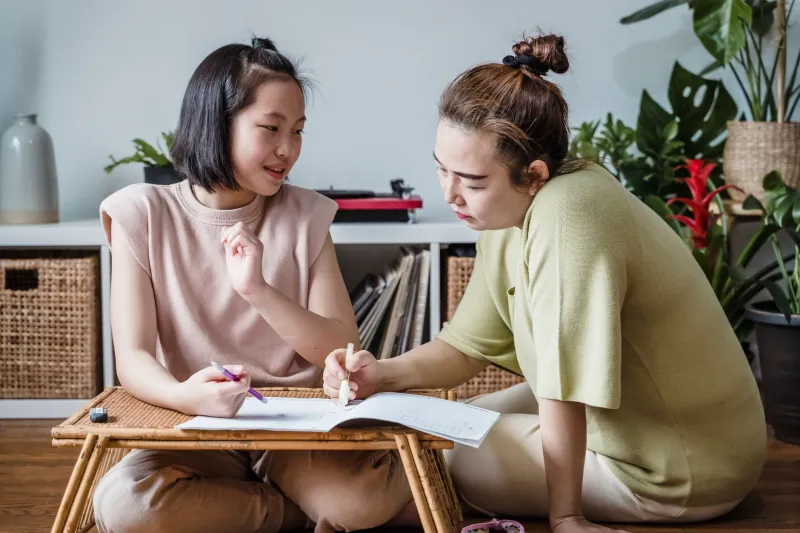
The movie also avoids the opposite mistake: pretending that feelings are enough. The mother still has to help with the homework. The daughter still has to practice. The emotional conversation opens a door, but the math has to walk through it. In one of the film’s most tender passages, the two work side by side with a visual model, drawing boxes and shading them until a fraction stops being a threat and becomes a shape. It is not glamorous. It is better than glamorous. It is ordinary.
Breaking the Cycle at the Kitchen Table
For US parents who recognize themselves in that kitchen scene, the film offers a useful starting point rather than a checklist. The goal is not to perform confidence. It is to interrupt the automatic handoff.
Start by separating the person from the performance. A child who is stuck is not a child who is bad at math. A parent who feels panic is not a parent who has failed. Say the thing out loud: I am feeling my own math nerves, and it is not about you. That sentence sounds small, but it changes the emotional geography of homework.
Next, narrate your discomfort without making it contagious. There is a difference between saying, I hated math too, so I get it, and saying, I used to think being confused meant I was bad at this. The first builds solidarity. The second builds a new interpretation. Confusion becomes information, not identity.
Ask better questions than whether the answer is right. Try: What part feels sticky? Where did your brain lose the thread? Which model helps you see it? These questions move the conversation away from judgment and toward process. They also give a parent something to do besides hovering with a red pen.
Finally, plan for repair. Most families will not get the calm, insightful version on the first try. Homework happens when everyone is tired, hungry, and out of patience. The repair matters more than the perfect start. A short reset after a blowup can do more than a forced apology. I raised my voice because I got worried. Let us try again after water. That is not indulgence. That is modeling how to return to difficult work.
The Remainder Is Not the Whole Story
La Mama understands that a mother and daughter do not leave a math problem with a clean answer. There are remainders. There is the fear that lingers, the old habit of shrinking, the memory of a bad teacher or a bad night. But the film’s title is not about perfect equations. It is about the person beside you while you work them out.
That is why the kitchen-table scene stays with audiences. It is not really about fractions. It is about what happens when a parent stops hiding their own history and a child stops carrying it alone. In the language of the movie, the inheritance does not disappear. It gets talked about. And sometimes, that is the first real solution.