Raised Hands, Loaded Question: Inside La Mama’s Festival Q&A Survival Kit

The Hand That Always Goes Up
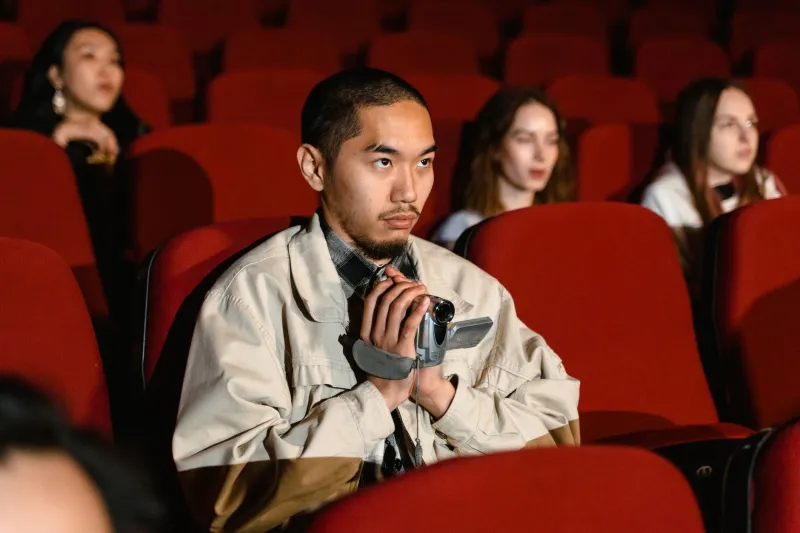
At a festival Q&A, you can set your watch by it. The credits roll, the applause starts, the moderator opens the floor, and before anyone can ask about the score or the shooting schedule, a hand shoots up in the third row. The question is almost always some version of: “Is this based on your life?”
At La Mama screenings this year, that moment has become its own tiny piece of theater. The cast and crew know it is coming. The audience knows it is coming. The moderator usually knows it is coming and tries, with varying success, to get there first. It is not a hostile question. It is a compliment wearing a trench coat. But it is also a trap, because the easy answer is never the true one.
“I love that you think I have a life this interesting,” our lead says when the mic reaches her. The room laughs. Then she leans in. “The feelings are borrowed from real life. The events are built. That distinction is the whole movie.”
Why the Question Lands So Hard
Motherhood and math are personal subjects. Put them in the same frame and audiences start seeing their own kitchens, their own report cards, their own mothers sighing over a calculator at 9 p.m. That recognition is the point. When someone asks if La Mama is autobiographical, they are often asking a different question: Did you see me in this?
The dangerous move is to answer yes. A flat yes turns a collaborative film into a memoir, erases the work of the actors, editors, designers, and math consultants, and invites the follow-up that every filmmaker dreads: “So which one is you?” A flat no is worse. It sounds defensive, as if the movie has no blood in it.
Our director has a line for this. “The movie is autobiographical the way a lasagna is autobiographical,” she says. “Someone cooked it. Someone had a childhood. But you are not eating the childhood.”
The La Mama Three-Step Dodge (That Is Not Really a Dodge)
What looks like a dodge onstage is actually a small piece of craft. The team calls it the three-step answer, though nobody has printed it on a T-shirt yet.
First, acknowledge the feeling. “That is the best compliment we can get,” the director says. Second, name the variable. “The emotional math is real. The events are assembled.” Third, hand the audience a concrete detail they can chew on. “Ask us about the fridge door,” our lead likes to say. “That was a decision.”
It works because it respects the question without surrendering the film to it. The audience gets a window into the process. The filmmakers get to keep some of the equation unsolved. And the moderator gets to move on before someone asks whether the daughter’s geometry homework was actually from a real textbook.
For the record: it was not. But the panic was.
A Word Problem for Festival Season
Here is the math behind a good answer. Let x equal what actually happened. Let y equal what the story needs. Let z equal what the audience brings through the door. A movie is not x. A movie is a function of x, y, and z. If you solve for x alone, you get a memoir, not a movie.
That is why the cast and crew rarely give a simple yes or no. The lead borrows a real memory of her mother’s exhaustion, then hands it to a fictional daughter with a fictional theorem and a fictional chalkboard. The director starts from real conversations with mothers and math teachers, then builds a fictional machine around them. The math consultant checks the equations. Nobody checks the autobiography, because that is not the assignment.
The proof is by counterexample: if every detail were true, we would have a documentary with worse lighting and a much longer runtime. The film is better than that. It is a true story about a feeling, assembled from parts that were not literally true.
What the Cast Says When the Mic Reaches Them
Ask different people on the team and you get different versions of the same answer.
“My mother never solved a theorem on a chalkboard,” our lead says. “But she solved the same problem every night at 9 p.m. with a calculator and a sigh. That is the part I stole.”
Our director puts it another way: “We started from real conversations, real anxieties, real homework fights. Then we built a fictional family and gave them better lighting. The emotional truth is real. The plot is a machine we built to carry it.”
The math consultant is blunter. “The math is accurate. The family is invented. The panic is universal.”
And the costume designer, who has been asked about the cardigan more times than any of them, has the best short answer: “The sweater is real. The stain is a decision.”
The Follow-Up Is the Real Test
Festival Q&As are not court depositions. They are conversations with a room full of people who just spent 98 minutes in the dark with your movie. The follow-up to the autobiography question is usually softer than it sounds: “But which one is you?”
Our director has a response that stops the room every time. “Whichever one you needed to see,” she says.
That is not a dodge. It is the whole point. La Mama is not a confession. It is a story built to let mothers and daughters and math teachers and former gifted kids find themselves in the frame. If the film were strictly autobiographical, it would be smaller. If it were strictly fictional, it would be colder. The mix is the magic trick.
At one 2026 screening, a woman stood up during the Q&A and said, “I am asking because I am the mother in this movie.” The room went quiet. Our lead nodded and said, “Then you already know the answer.”
Keep Some of the Equation Unsolved
A good Q&A answer does not close the loop. It leaves one variable open so the audience can keep solving it on the drive home. That is why the team never hands out a neat little map of what is true and what is invented. The question is not a trap. It is a doorway.
So if you see a hand go up at our next festival stop, do not worry. We have a proof ready. It starts with a laugh, passes through a word problem, and ends with the truth: the movie is not our life. It is the math we did to survive it.