Every Dollar Has a Theorem: Following La Mama's Money From Kickstarter to the Marquee
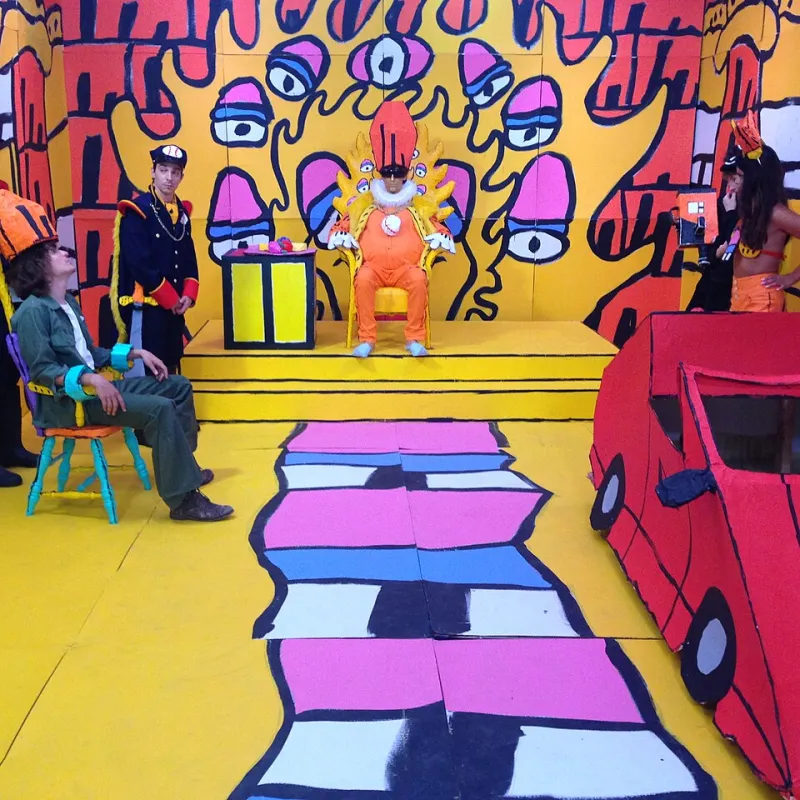
Photo: Adam Green, CC BY-SA 4.0, via Wikimedia Commons
There's a moment in every indie film's life when the math stops being metaphorical. For us, that moment arrived on a Tuesday in March, when our post supervisor emailed a quote with the subject line: "This is everything, unfortunately."
La Mama was never going to be a studio picture. We raised $187,000 through a Kickstarter campaign that our director's mother promoted at her church, her book club, and — allegedly — a DMV line. But raising the money turned out to be the easy equation. Getting the finished film in front of audiences is a word problem with no clean solution. So we're doing something indie films rarely do: showing our work.
The Proof, Line by Line
A good proof starts with your givens. Ours: one finished feature, one no-name (for now) cast, zero distribution deal, and a festival acceptance that came with a hard deadline and a projection spec we had to Google.
Line 1: The DCP. Every commercial screening requires a Digital Cinema Package — essentially your film converted into a format theaters can actually project. Cost: $1,800, plus $400 in corrections after our first test screening revealed the subtitles were slightly off-center. Painful? Yes. Cheaper than a reshoot? Infinitely.
Line 2: Festival fees and submissions. We submitted to 23 festivals. At an average of $45 a pop, that's roughly $1,035 — and that's before the Sundance-tier submissions that run $85 to $100 each. Our producer keeps a spreadsheet color-coded by heartbreak level.
Line 3: Travel. When La Mama got into a regional festival in Ohio, two of us flew out on a Tuesday red-eye, shared one rental car, and slept at our sound designer's cousin's place. Total: $1,240. Would a studio spend that? No. Would we do it again tomorrow? Also no — but yes.
Line 4: The press kit. Here's a fun industry secret: half of what makes a film look "real" is paperwork. Stills, a synopsis in three lengths, bios, a poster, a trailer cut under two minutes. Our publicist — a freelancer who took us on because, in her words, "the mom-math thing is weird enough to pitch" — built ours for $3,000. It has opened more doors than any single frame of footage.
Line 5: The long tail. QC checks, closed captioning, a deliverables package for streamers, music licensing paperwork for the one song we couldn't live without. Call it $4,500 of deeply unsexy necessity.
What the Money Doesn't Buy
Notice what's missing: marketing at any real scale. A studio spends more on a poster than our entire budget. So we do what micro-budget filmmakers have always done — we lean on the people in the seats. Every Q&A, every mom who drags her book club to a Tuesday matinee, every math teacher who posts about the film on a Sunday night: that's our marketing department.
The Playbook, If You're Counting
For the filmmakers reading this: budget 20 percent of your raise for the road after the film is finished, not before. For the film buffs who fund us: your ticket isn't charity, but your word-of-mouth is infrastructure. Crowdfunding got us to the finish line. Audiences are the ones who carry us past it.
QED — or as close as indie distribution ever gets.